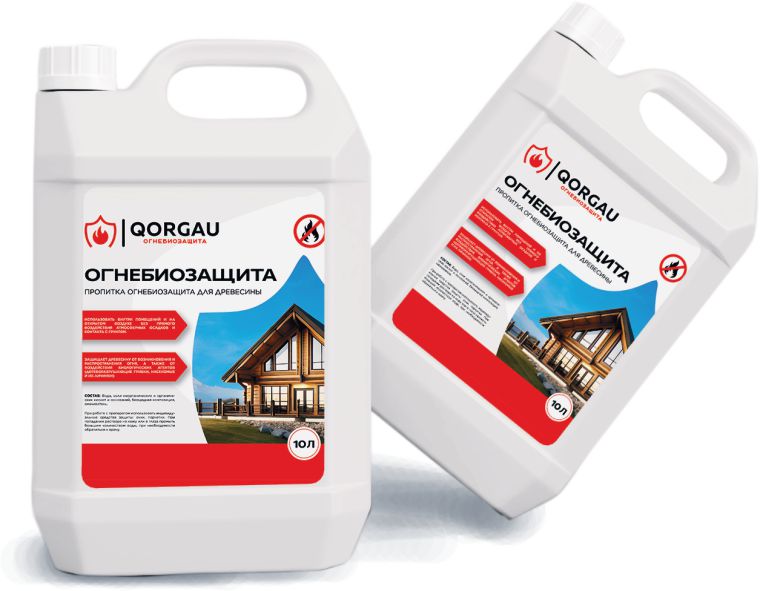
QORGAU paint - fire and bioprotection
Fire and bio-protection concentrate for timber: protects against fire, rot, mold and wood-destroying fungi.
- Application
- Timber
- Properties
- Biological protectionFire protection
Description and specifications
Product features
Fire and bio-protection of wood: a reliable fire-retardant paint for long-term timber protection. Fire resistance: our fire-retardant wood paint provides a high level of protection, effectively increasing the fire resistance of wood and the time it stays non-combustible when exposed to flame. Safety: thanks to its unique formula, the fire-retardant impregnation reduces the risk of ignition and significantly reduces the release of toxic gases and smoke in a fire, adding safety for people and property. Durability: the fire and bio-protection agent forms a strong, stable protective layer that keeps its properties through long service and in adverse environmental conditions. Suitable for residential, commercial and industrial facilities.
Purpose
Fire protection of timber structures and wood-based materials (particleboard, fibreboard, plywood) in efficiency groups I and II under ST RK 615-1-2011, as well as bio-protection against rot and wood-destroying, wood-staining and mold fungi. Suitable for indoor and outdoor use.
Protection period
Up to 12 years in dry or normal indoor conditions and up to 3 years outdoors under a canopy. Operating temperature from −50 to +50 °C. Does not form salt efflorescence and tints the timber amber.
Solution preparation
The liquid concentrate is diluted with water 1:2 (10 l of concentrate to 20 l of water); water not colder than +18 °C; mix for 3–5 minutes. It is best to use the whole pack at once.
Application
By brush, roller or sprayer; group I in 2 coats, group II in 1 coat, 2–4 hours drying between coats. Immersion is permitted. Full fire protection is achieved after 10–14 days.
Consumption
For group I on smooth planed dry timber: 68 g/m² of concentrate (204 g/m² of solution); for group II: 41 g/m² (123 g/m²). For unplaned surfaces consumption increases by a factor of 1.6.